Tradition
Polka, furiant and mazurka
Which dances you may meet at a Czech folk dinner, where the polka, the furiant, the verbuňk and the mazurka come from, and what to try.
Book the folk dinner ↗Quick answer
The polka is a Czech dance, the furiant is a proud Bohemian dance in changing rhythms, the verbuňk is an improvised dance of Slovácko, and the mazurka, which the booking page names, is Polish. A folk dinner may mix them, and guests are invited to learn traditional steps. The programme varies, so treat these as the dances behind the evening and not as a list for your night.
What the booking page says
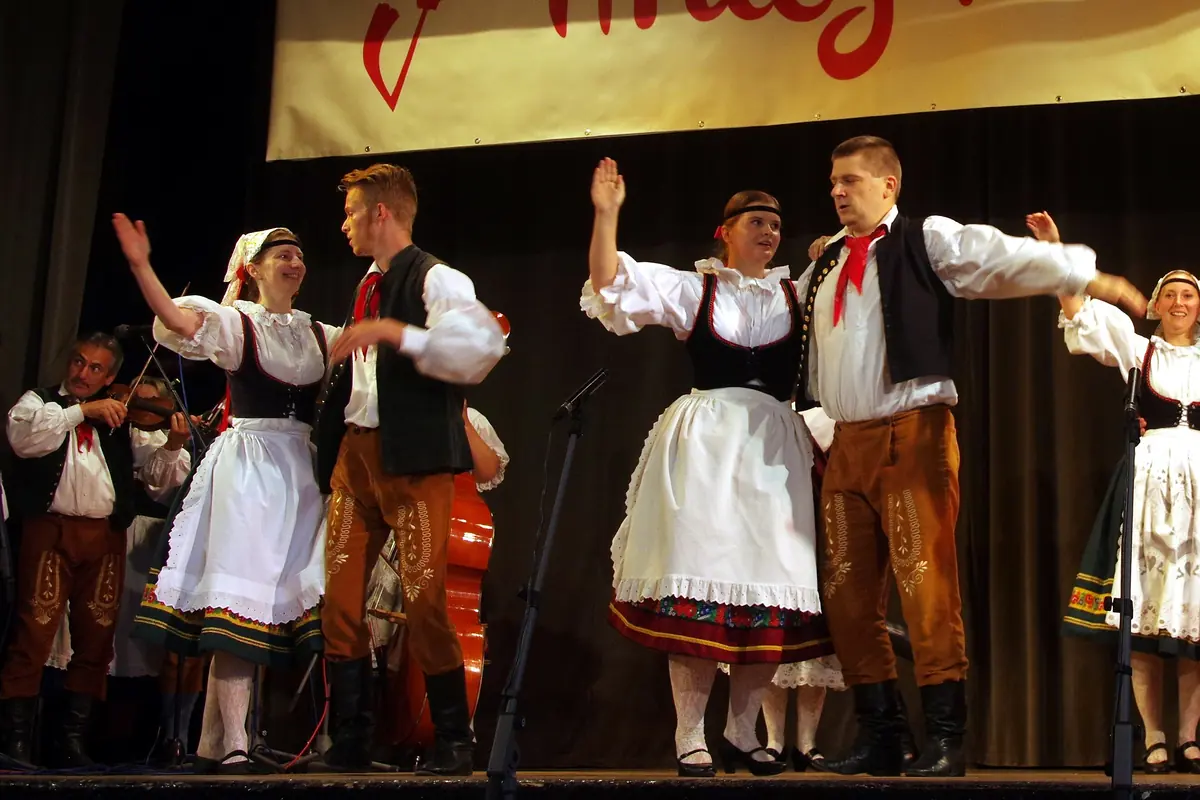
The booking page says guests watch a folkloric dance show with dancers and musicians in costumes from the Czech and Moravian regions, listen to songs from Bohemia and Moravia and learn traditional dance moves, such as the mazurka. It does not publish a list of dances for a given night. This guide therefore explains four dances you may meet in Czech folk culture, so that if one appears, you know where it comes from. The photograph shows costumed performers at a festival in Strážnice, not at this restaurant.
The polka
Wikipedia says the polka is a dance style and genre that originated in nineteenth-century Bohemia. The name is believed to derive from the Czech word půlka, meaning half-step, and the dance is in 2/4 time. It reached Prague ballrooms by 1835 and Vienna by 1839, and in Paris its popularity was called polkamania. Historians believe the polka evolved as a quicker version of the waltz. It is the dance most associated with Bohemia, and Wikipedia's entry on Czech music names the Bohemian polka as a famous regional dance.
The furiant
Wikipedia describes the furiant as a Bohemian folk dance with a rapid tempo and irregular, changing rhythms, performed in pairs. The male dancer plays a proud, showy suitor while the female dancer moves lightly around him, and the style mocks the smug arrogance once associated with farmers. The article says it became a national symbol in the nineteenth century, especially after Smetana's The Bartered Bride, and that Dvořák wrote furiants in his Slavonic Dances. Its origin and the origin of its name are disputed.
The verbuňk
According to Wikipedia, the verbuňk of Slovácko is danced by improvising, in the districts of South Moravia and Zlín, and UNESCO listed it in 2008 as intangible heritage. Wikipedia's entry on Czech folklore describes verbuňk songs and dances as linked to conscription and regional. As an improvised dance, it varies from one performance to the next. Whether it appears at a dinner show depends on the ensemble, and the booking page does not name it.
The mazurka, a Polish guest
The booking page names the mazurka as a dance guests learn. Wikipedia describes the mazurka as a Polish musical form based on stylised folk dances in triple metre, with the name linked to Mazovia. It became popular in ballrooms across Europe in the nineteenth century, and Wikipedia notes that Czech composers Smetana, Dvořák and Martinů all wrote mazurkas to some extent. So the mazurka belongs to the wider Central European dance repertoire as well as Poland's own. If you expect only Czech dances, this one is the surprise.
Dvořák and the dances
Dvořák's Slavonic Dances, composed in 1878 and 1886 and published as Op. 46 and Op. 72, show how these dances entered concert music. Wikipedia says most of them use Czech dance patterns, including the furiant, the sousedská, the skočná and the špacírka, while the polka and the mazurka also appear. The article adds that he used Brahms's Hungarian Dances as a model, but drew mostly on the rhythms of Bohemian folk music. If the music sounds familiar, that is partly why.
Joining in
The booking page says guests learn traditional dance moves and become part of the show. An evening that teaches steps is built for beginners, so nobody is expected to arrive knowing them. Wear comfortable shoes, watch the dancers' feet first and expect a lively rhythm. If you prefer to watch, the dinner and the drinks continue around you. The main guide describes the whole evening in order.
Read next: Czech folk dinner: what happens
Who this isn't for
If you want a performance of one named dance in a theatre, such as a staged polka or verbuňk by a national ensemble, a dinner show is not that. The dances here are mixed with dinner and audience participation, and the booking page does not publish a programme. If you dislike being asked to join in, choose a seated concert instead.
Frequently asked questions
Is the polka really Czech?
Yes. Wikipedia says the polka originated in nineteenth-century Bohemia, and its name is believed to come from the Czech word půlka, meaning half-step.
Is the mazurka a Czech dance?
No. Wikipedia describes it as a Polish form linked to Mazovia. The booking page names it as a dance guests learn, so expect a mix.
What is a furiant?
A Bohemian folk dance in rapid, changing rhythms, performed in pairs, with a proud male dancer and a lighter female dancer, according to Wikipedia.
Sources