Tradition
Czech kroje, explained
What a kroj is, how Czech folk costume differs between Bohemia, Moravia and Slovácko, and what to look for when the dancers come on.
Book the folk dinner ↗Quick answer
A kroj is a Czech folk costume. Each region, and often each village, has its own cut, embroidery, colours and ribbons, and Moravia kept its costumes better than Bohemia. Today kroje are worn mainly by folklore ensembles and at festivals. At a folk dinner show the dancers wear them, and knowing a few details turns a colourful blur into something you can read.
What a kroj is
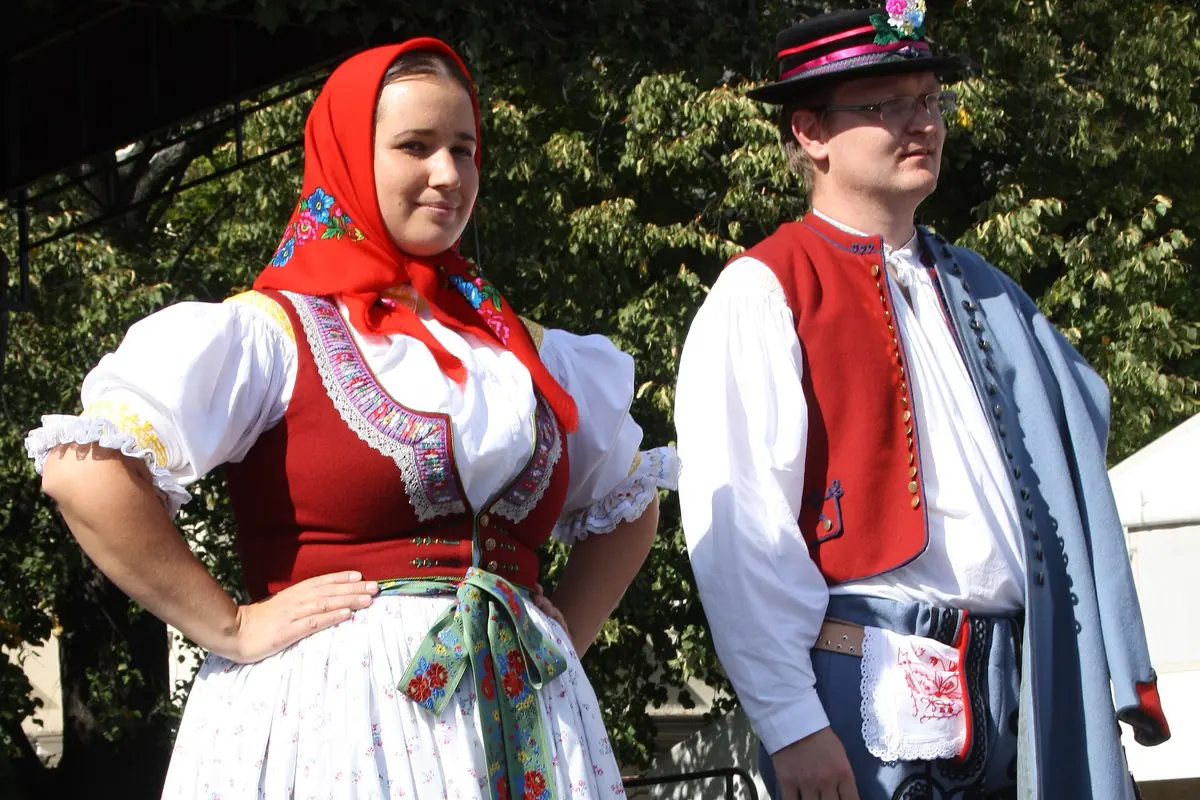
Czech Wikipedia defines a kroj as a distinctive garment of a particular ethnographic, professional or community group, often handed down through generations. Every costume has recognisable features: the style of embroidery, the lace, the cloth, the colour and the cut. The article covers Bohemia, Moravia and Silesia, each divided into many sub-regions. The booking page promises dancers and musicians in costumes from the Czech and Moravian regions, which is why this background is worth a few minutes.
Why costume varies
The same article says costumes varied by rank, occasion, season and occupation. Poorer people wore simpler cloth and decoration, while peasant families wore richer fabrics with more ornament, and festive, wedding and ceremonial dress was kept apart from work clothes. Wikipedia's general entry on folk costume says it expresses the cultural, religious or national identity of a region or group. That is why a kroj is read as a map: it tells you roughly where its wearer comes from.
Bohemia and Moravia
Czech Wikipedia says the Prague area gave up its folk dress early, so many costumes from around the capital are modern reconstructions. It says Moravia kept its costumes better than Bohemia. The most prominent costume to survive in living form to the present, it says, is the kroj of Chodsko. If your evening includes Bohemian songs and Moravian ones, as the booking page says it does, the costumes may signal which tradition a number belongs to.
Slovácko and its embroidery

Czech Wikipedia lists Slovácko among the regions where several distinct costume types are kept in living tradition, including in the sub-regions of Horňácko and Dolňácko. English Wikipedia calls Moravian Slovakia a cultural region in the south-east of the Czech Republic, known for its folklore, music, wine, costumes and traditions. The photographs on this page show festive costumes of Slovácko at a wine festival in Uherské Hradiště, not the dancers of this restaurant, and they show how heavily embroidered the region's skirts and vests can be.
What to look for
Czech Wikipedia describes several details worth spotting. Men's vests are often decorated with embroidery and buttons. Women's bodices, called kordulka, frydka or živůtek, are decorated with ribbons, and skirts are often edged with ribbons. Shirts, sleeves, collars and aprons carry regional embroidery patterns. You do not need to name each one. Notice whether the embroidery is dense or sparse, whether the ribbons are long or short, and whether the colours are bright or restrained, and compare the dancers on stage.
Costume today
Czech Wikipedia says the costume is now a symbol of folk celebrations and customs that are maintained or revived, and that you meet it at folklore festivals. English Wikipedia's entry on Czech folklore says traditional dress is now mostly worn by folklore ensembles and at festivals. Its article on the Ride of the Kings in Vlčnov, which UNESCO inscribed in 2011, says village women make the costumes and horse decorations, which follow traditional colours and designs specific to each village. A dinner show is a staged version of that tradition, performed for visitors.
Read next: Czech folk dinner: what happens
Who this isn't for
If you want a museum or a festival where the costumes are the main event, a dinner show is the wrong format. The costumes here are part of an evening that also includes dinner, drinks and joining in. It is also not a lesson in regional ethnography: the booking page promises costumes from the Czech and Moravian regions, not a guided tour of each type. Treat this guide as background for your eyes, and do not expect the dancers to wear any one specific regional costume.
Frequently asked questions
What is a kroj?
A kroj is a Czech folk costume, a garment with recognisable embroidery, lace, cloth, colour and cut that marks a region or community. The plural is kroje.
Is Czech folk costume worn every day?
No. Wikipedia says traditional dress is now mostly worn by folklore ensembles and at festivals. Costumes remain a symbol of maintained or revived folk celebrations.
Which region kept its costumes best?
Czech Wikipedia says Moravia kept its costumes better than Bohemia, and names Chodsko, Slovácko, Haná and Valašsko among the regions with notable costumes.
Sources