The music
Bohemian, Moravian, Slovak songs
What separates Bohemian, Moravian and Slovak folk songs at a Prague folk evening, plus the Romani songs and the classical dances that follow.
Book the cellar evening ↗Quick answer
The booking page promises traditional music, then a programme of Bohemian, Moravian and Slovak folk songs and what it calls gypsy songs. Bohemian music includes the bagpipe music of Chodsko, Moravian music is known for the cimbalom, and Slovak music has the fujara. Romani musicians shaped much Central European music, and the classical finale borrows folk dances.
What you are promised
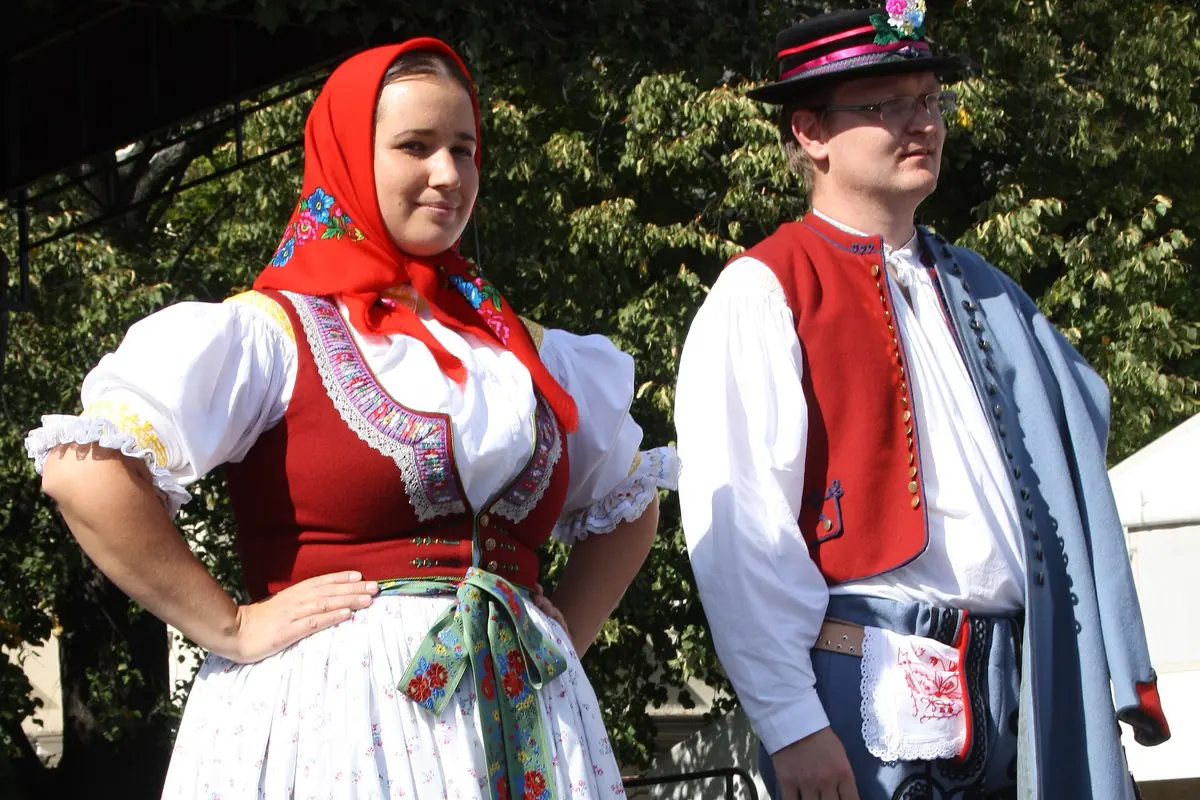
The booking page says four musicians play all evening, first traditional music, then a programme of Bohemian, Moravian and Slovak folk and gypsy songs. It also says every evening is different according to the mood of the guests, so no song list exists. This guide explains the traditions the songs come from. The photograph shows festive costume from Moravian Slovácko at a wine festival in Uherské Hradiště, not the musicians of this evening.
Bohemia
Wikipedia's entry on the music of the Czech Republic says Bohemian traditional music includes that of Chodsko, a region where bagpipes are common, and names the Bohemian polka as a famous regional dance. Wikipedia says the polka originated in nineteenth-century Bohemia and that its name is believed to come from the Czech word půlka, meaning half-step. If a song in the programme has a bouncing two-beat rhythm, it may be a polka.
Moravia
The same entry says the traditional music of Moravia displays regional influences, with ties to Slovakia and Poland, and is known for the cimbalom, played in ensembles with double bass, clarinet and violins. Wikipedia describes Moravian Slovakia as a cultural region in the south-east of the Czech Republic, known for its folklore, music, wine, costumes and traditions. That is the region whose wine cellars give the booking page its glass pipes.
Slovakia
Wikipedia's entry on the music of Slovakia says the country has a rich heritage of folk music, and that in the countryside folk music developed in a more insular manner in the country's various regions. It names the fujara as a traditional Slovak shepherd's pipe and says the fujara and Slovak bagpipes existed in the fifteenth century. In a programme crossing three regions, the fujara is the instrument that most clearly marks the Slovak part.
The Romani songs
The booking page names gypsy songs alongside Bohemian, Moravian and Slovak ones. Wikipedia uses the word Romani and notes that some Romani consider the English word Gypsy derogatory, so this guide says Romani. Its entry on Romani music says that in the early nineteenth century Romani musicians came to the forefront of national music in Hungary, and that music played for outsiders is called Gypsy music while music played among Romani is called folk music.
From the village to the concert hall
The evening ends with classical works inspired by folk dances. Wikipedia says Dvořák's Slavonic Dances, composed in 1878 and 1886, mostly use Czech dance patterns such as the furiant. Brahms's Hungarian Dances draw mostly on Hungarian themes in a gypsy style. Sarasate's Zigeunerweisen dates from 1878, and Monti's Csárdás from 1904 is based on a Hungarian csárdás. The finale shows how folk dances travelled, a theme the comparison guide explores.
Read next: Folk evening or classical?
Who this isn't for
If you want to learn the origin of a particular song, a lively group evening is the wrong format: the musicians play a mixed programme, and the booking page gives no song titles. If you want only Czech music, note that the programme includes Slovak and Romani songs and a finale with Hungarian and Spanish composers. The main guide describes the whole evening, and the instruments guide explains the sounds.
Read next: Dulcimer, fujara and bagpipe
Frequently asked questions
Which regions do the songs come from?
The booking page names Bohemia, Moravia and Slovakia, with gypsy songs. This guide uses the word Romani for that tradition.
Will I hear the polka?
The programme varies, so no dance is promised. The polka originated in nineteenth-century Bohemia, so it is a possible guest.
Are the songs in English?
The booking page does not give song texts. The music needs no translation, and the host speaks English.
Sources
- Czech folklore, encyclopedia entry
- Music of the Czech Republic, encyclopedia entry
- Music of Slovakia, encyclopedia entry
- Moravian Slovakia, encyclopedia entry
- Romani music, encyclopedia entry
- Polka, encyclopedia entry
- Slavonic Dances by Dvořák, encyclopedia entry
- Zigeunerweisen by Sarasate, encyclopedia entry